cultural

citymaking.wien – Pop Up Parklets!

Citymaking.wien
Important information: Please do not forget to answer our survey (6.5 min). Thank you!
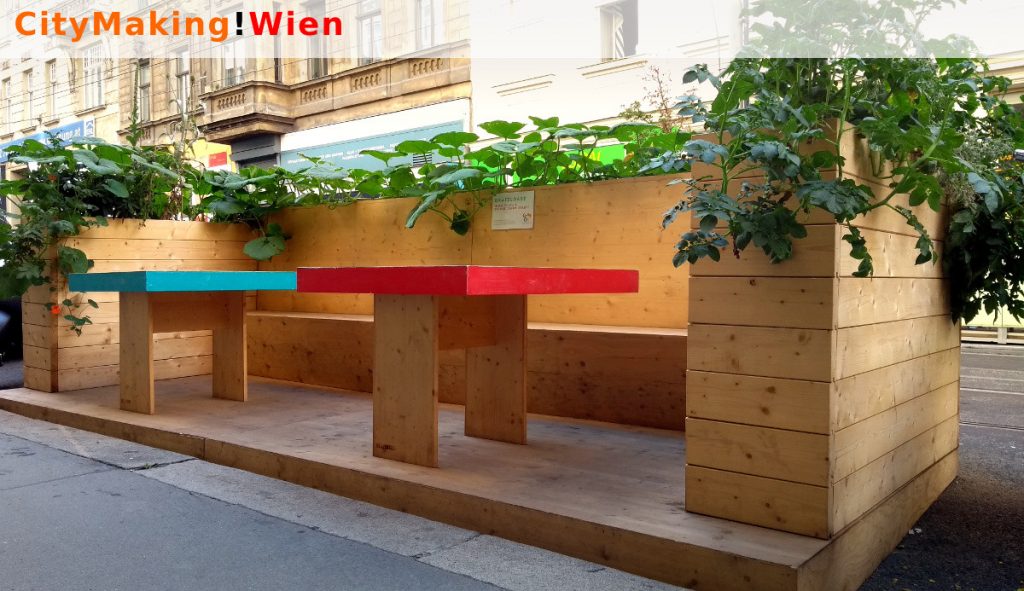
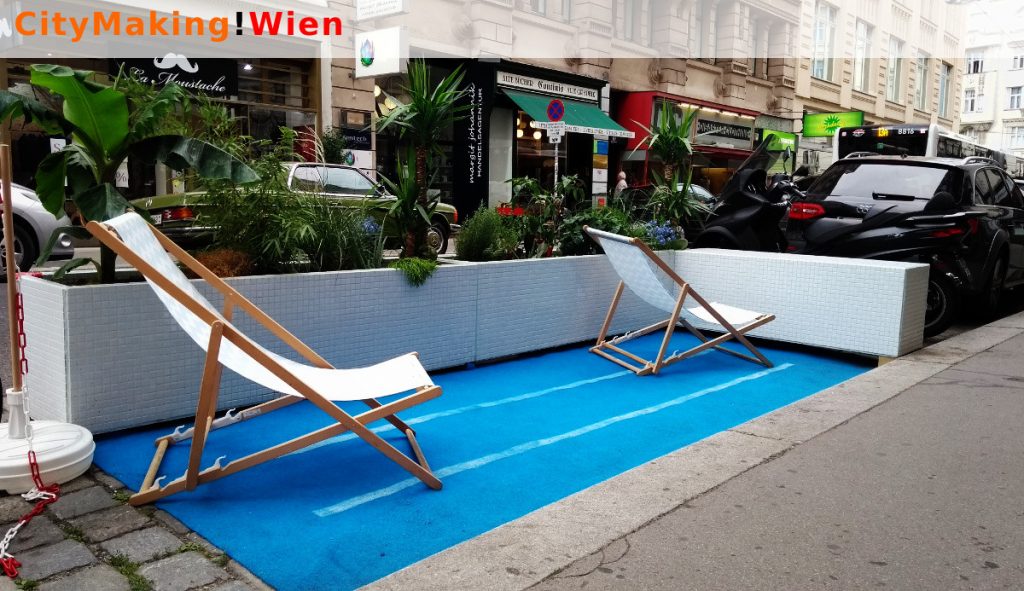
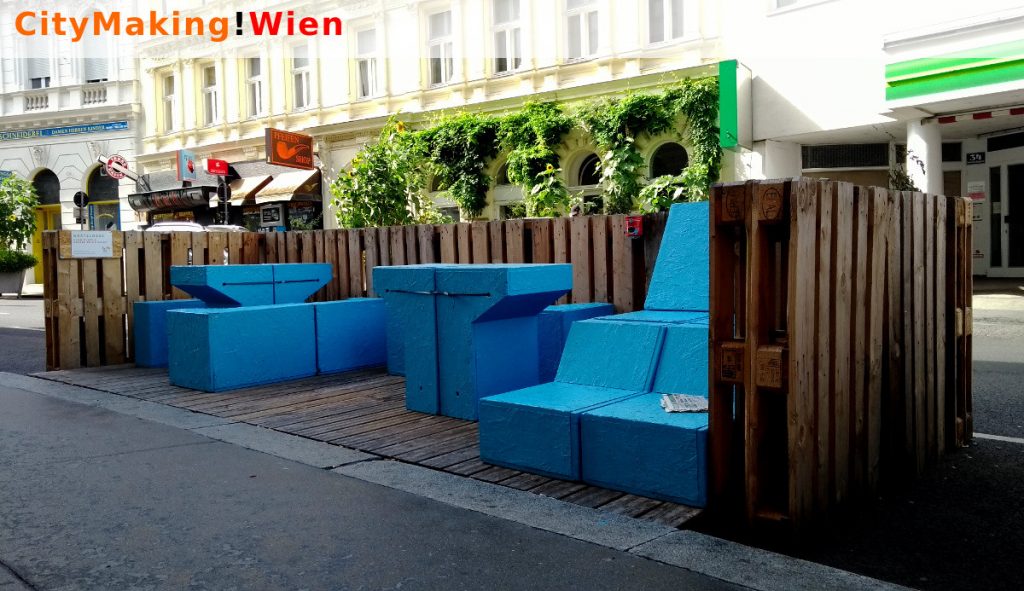
CityMaking!Wien is an online toolbox that facilitates the conception, design and submission of parklets in Vienna. With this tool we want to make it as simple as possible for the citizens to participate in the development of their neighborhoods.

At the moment CityMaking!Wien offers four different tools:
  1. Basic information about parklets and what should be considered for the conception and construction of a parklet in Vienna, regarding the security, the design and other aspects.
  2. A parklet potential map that shows where would be possible to build a parklet, by showing in red the different restrictions that apply for the use of parking places. The map simplifies the understanding of the regulations and offers a new understanding about public spaces.
  3. A design tool that facilitates the creation of the required drawings for the submission. The tool is very simple to use, yet it has considered many of the requirements regarding dimensions and security. People can also download the drawings and edit them according to their own visions.
  4. An online submission tool that facilitates the contact with the authorities and the submission of the required documents to obtain a permit for the use of parking places.
With these tools we want to encourage people to become active and submit their ideas using the online form. The final decision regarding the use of parking places is taken by the city of Vienna. The toolbox is a great example on how technology can trigger new dynamics in cities, by providing new understandings of public spaces.

Last but not least CityMaking!Wien is also testing the impact of technology in citizen participation. We want to find out if technology does truly fulfill the promise of making participation and engagement easier, or if web-applications really encourage people to become active in their neighborhoods.

To answer these questions we are running an online survey and we are really thankful for your answers and your time (it takes in average 6.5 minutes). The website is being develop as part of the PhD thesis “New methods of citizen participation based on digital technologies” at the Austrian Institute of technology.
Citymaking.wien Citymaking.wien Credits: Conception and development: Juan Carlos Carvajal Bermúdez, Matthias Herret.
Host organization: Austrian Institute of Technology
Media Partners: mediaarchitecture.org, streetlife.wien.

Blitzfänger for “Human Futures” @ Aspern Seestadt


BLITZFÄNGER is an interactive installation that allows up to 9 people to create and control lightning on a large-scale LED screen. As a homage to the power of nature and our attempt to control it, the audience is invited to grab one of the 3 meter poles from the floor and position them vertically like lightning rods. As soon as they do a system detects their position and lightnings appear on the LED screen allowing them to control them with their movement.

This project was created as part of the ‘Human Futures’ program of artistic exchange between Europe and Canada and under the ‘living spaces’ curatorial theme. BLITZFÄNGER took place at the entrance of a new residential complex outside of Vienna in between the train and the buildings and was designed to disrupt the routine of the inhabitants that just go in and out of the complex allowing them to get to know, or at least see the people they live around.

Created by Iregular
Concept, graphic and sound design: Daniel Iregui
Technical Direction: François Loubert-Hudon
Technical Assistance: Juan Carvajal
Produced by: Media Architecture Institute
Powered by: X-Agora
Curated by: Gernot Tscherteu

funded by the European Union
EU_flag_cult_EN

Ben Stricker, Wolfgang Leeb

Ben Stricker, Wolfgang Leeb, members of the Media Architecture Institute, talk about the installation called City bug report, created for the city hall tower of Aarhus. They equipped the railings of four floors in the tower with LED strips. This setup allowed to display some low-res images in different sides of the building. They successfully tackled all the challenges related to the installation of more that 4000 LEDs from AHL on the tower. For that they got the help from the production team of CAVI in Aarhus. Installing power and signaling across different floors proved to be a demanding task, that took about three days to be completed. However they succeeded in their attempt and the installation became a reality.

Jaimie Allen

Jaimie Allen talks about the doctoral consortium at the Media Architecture Biennale. He mentions that the consortium is a forum where people coming from different backgrounds and departments can meet and discuss about topics that are shared. It is an opportunity to transgress the rigid structures of the university and talk in a relaxed environment about the own research and experiences. For example persons working on Interaction design or electronics can talk with people looking at public spaces.

Alexander Wiethoff, Martin Tomitsch

Alexander Wiethoff, Martin Tomitsch, members of the Media Architecture Institute, talk about the workshops of the Media Architecture Biennale. There is a broad spectrum of workshops formats, including industry, hands-on, and studio tours. In a way they represent that Media Architecture is a broad field, that includes media artists, researches at HCI and local designers. The workshops are a platform to communicate and exchange ideas about media, technology and architecture in the city. The interdisciplinary collaboration is a key aspect of the workshops, and they represent an opportunity to exchange ideas, knowledge and include such into to the own practice.

Alexandros Tsolakis – David Bajt

Alexandros Tsolakis and David Bajt from United Visual Artists talk about the working process at U.V.A. and how the creative process is steered to achieve the best results. Brain storming plays an important role in their work process, it allows them to collect ideas which are later distilled and polished by the team. They also talk how model building and prototyping work also plays an important role in the creative process, and getting away from the computer can boost actually improve the results and accelerate the testing of ideas. Especially lighting can be better tested through models, as lighting simulation can be a time intensive activity that nevertheless does not delivered the best results.

Gernot Tscherteu

In this video Dr. Gernot Tscherteu talks about the exhibition of the Media Architecture Biennale. He mentions that the exhibition has become a meeting place for designers, architects, and academics working in the area. He also explains that the projects exhibited at the Media Architecture Biennale are also available online, or through an iPad app. You can visit the online exhibition at catalog.mediaarchitecture.org

Sanxing Cao

In this video professor Sanxing Cao talks about Media Architecture in China. In such a big country like China there are big differences between the different cantons. Sanxing Cao talks about three main trends in the development of media in China. Smart media, which is the integration information and communication technologies into common media systems, the second one is called ambient media, which encompasses media facades and outdoor media that can be found in common environments, the last one is natural media, which is much more focused on the interaction of humans and media devices.

Call for projects: Visible city 2015

Connecting cities - Visible City 2015 Societal flows and processes become analyzed and visualized on urban media facades through using data which is generated by digital sensor networks and infrastructures that underlie our daily lives.

Challenging questions: How can we make social, environmental and inter-cultural processes visible and use the screens as black boards and visualization zones? What is the impact on the society, when invisible structures that underlie our daily life get visualized? What is the potential to create public awareness?

Call for proposals for the visible city 2015


Our today’s modern cities are hybrid structures in which technology is invisibly interwoven in the perception layers of our everyday lives. With the curatorial theme of InVISIBLE and VISIBLE Cities we want to develop an awareness on the changes which are hardly visible to the eyes and are underlying our nowadays cities.

We call for artistic scenarios to visualise invisible, embedded ‘smart’ urban infrastructures and analyse their impact on the technological transformation of our society in a broad and public discourse.

(more…)

Kim Halskov

Kim Halskov was the senior advisor of the Media Architecture Biennale 2012 and is a special advisor at the MAB14.

He thinks that the field has had a great evolution over the years and he sees the spaces for academic reflection on media and architecture as a great complement for the Biennale. “We have, I think, managed in a very good way to bring the traditional Media Architecture Biennale and introduce a few new things. I think the academic track, the doctoral consortium and the papers are really, -really- a plus for this field”.

The MAB14 promises to be even more interesting as Aarhus will be the European capital of culture in 2017. The city is already getting ready for such an event and the visitors of the MAB14 will have a glimpse into that process. “There will be a really intensive process here with urban installations over the next couple of years”.

The registration for the MAB14 is now open. We are looking forward to seeing you at the MAB14!